Reasoning & Coding Models — Benchmarked & Ranked | March 2026
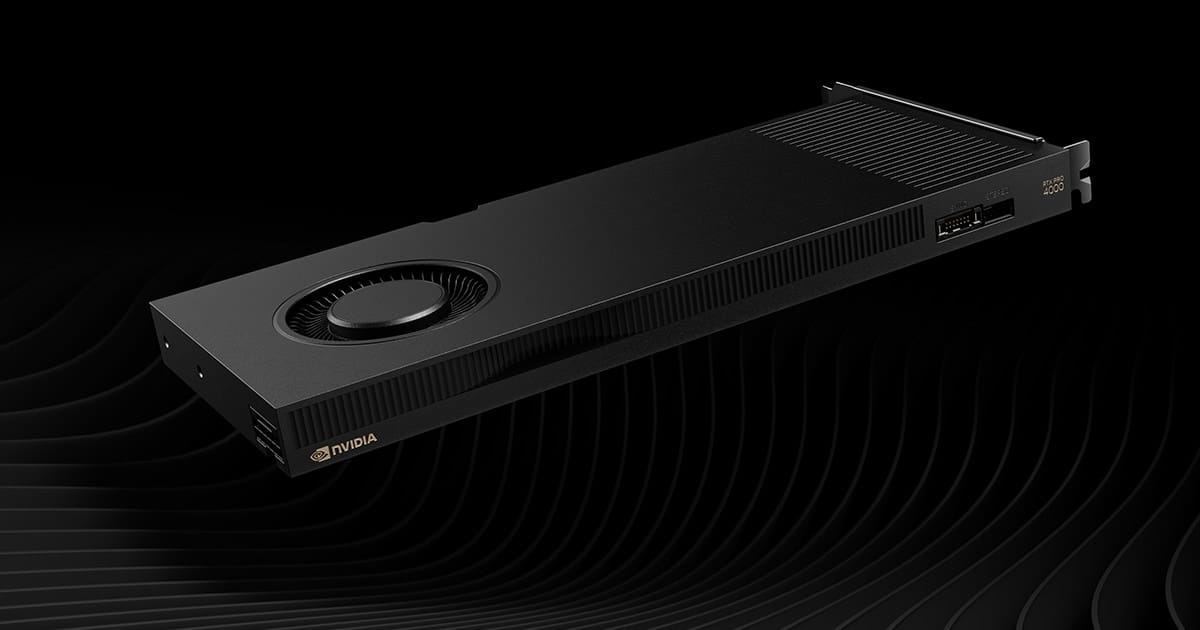
NVIDIA's RTX Pro Blackwell workstation cards represent a major step forward for professional AI inference. Both the RTX Pro 2000 and RTX Pro 4000 pack 5th-generation Tensor Cores with native NVFP4 hardware acceleration.
Specification Comparison
| Spec | RTX Pro 2000 Blackwell | RTX Pro 4000 Blackwell SFF |
|---|---|---|
| VRAM | 16 GB GDDR7 | 24 GB GDDR7 |
| Memory Bandwidth | 288 GB/s | 432 GB/s |
| CUDA Cores | 4,352 | 8,960 |
| AI TOPS | 545 | 770 |
| Form Factor | Half-height, dual-slot SFF | Half-height, dual-slot SFF |
| Tensor Core Gen | 5th gen (FP4 / NVFP4) | 5th gen (FP4 / NVFP4) |
| ECC Memory | Yes | Yes |
| PCIe | Gen5 x8 | Gen5 x8 |
The key difference: The Pro 4000 carries 24 GB and 50% more bandwidth — this unlocks a larger model tier (up to ~32B quantized) and noticeably faster token generation. The Pro 2000 at 16 GB still runs the most capable models in its VRAM class, particularly with NVFP4.
Why Blackwell Matters for LLM Inference
Both cards share the same generational AI advantage: native NVFP4 hardware acceleration. This format uses dual-level FP8 micro-block scaling with FP32 tensor scale, delivering:
- 1.6× throughput over BF16 on identical models
- 41% lower energy consumption at the same TDP
- Only 2–4% quality degradation versus full precision
The RTX Pro 2000 runs a 14B quantized model at 40–55 tokens/s. The Pro 4000 pushes that to 60–75 t/s. Both benefit from ECC memory — standard on all NVIDIA workstation GPUs — which protects against bit-flip errors during long-running inference sessions, an important reliability advantage for production deployments.
What Models Fit on Each Card
| Model | Size on Disk (Q4) | Fits Pro 2000 (16 GB) | Fits Pro 4000 (24 GB) | Notes |
|---|---|---|---|---|
| Qwen3.5 9B | ~7.5 GB | ✅ With headroom | ✅ Comfortable | Multimodal, 262K context |
| Gemma3 12B | ~9.9 GB | ✅ With headroom | ✅ Comfortable | Best conversational |
| Qwen3 14B | ~10.7 GB | ✅ Fits | ✅ Comfortable | Best reasoning @ 16 GB |
| Qwen2.5-Coder 14B | ~10.5 GB | ✅ Fits | ✅ Comfortable | Best autocomplete |
| DeepSeek-R1 14B | ~10.7 GB | ✅ Fits | ✅ Comfortable | Chain-of-thought reasoning |
| GPT-OSS 20B | ~13.7 GB | ✅ Tight fit | ✅ Comfortable | Best overall @ 16 GB |
| Ministral 3.2 14B | ~13.0 GB | ✅ Tight | ✅ Good | Language quality |
| Qwen3 32B | ~22.2 GB | ❌ Too large | ✅ Fits | Pro 4000 exclusive |
| Qwen3.5 27B | ~16 GB (Q4) | ❌ Too large | ✅ Comfortable | Best chat coding @ 24 GB |
| Qwen2.5-Coder 32B | ~22 GB | ❌ | ✅ Fits | Pro 4000 exclusive |
Top Reasoning Models
1. GPT-OSS 20B — Best Overall for RTX Pro 2000
Released by OpenAI as an open-weight model designed specifically to run on 16 GB hardware with MXFP4 quantization, GPT-OSS 20B is the top pick for the RTX Pro 2000. It sits at 13.7 GB and is optimized to run efficiently on Blackwell's MXFP4-capable Tensor Cores.
| Metric | Value |
|---|---|
| VRAM usage | 13.7 GB (MXFP4) |
| Gen speed — Pro 2000 | ~30–40 t/s |
| Gen speed — Pro 4000 | ~50–65 t/s |
| Context window | 60K tokens |
| Logic benchmark | Perfect on structured reasoning |
| AI Index score | 52.1% |
Why it stands out: Unlike most models that slow significantly as context fills, GPT-OSS 20B maintains consistent generation speed across 60K context windows. For professional tasks — research synthesis, long-document analysis, mathematical reasoning — nothing else in this VRAM tier comes close.
⚠️ Pro 2000 note: With 13.7 GB on a 16 GB card, context beyond ~16K tokens may squeeze VRAM. For long-context RAG workloads, the Pro 4000 is the better fit.
2. Qwen3 14B — Best Reasoning for Both Cards
Qwen3 14B consistently beats or matches models twice its size on math and reasoning benchmarks, fitting comfortably in 10.7 GB at Q4_K_M and leaving generous VRAM headroom for context on both cards.
| Metric | Value |
|---|---|
| VRAM usage | ~10.7 GB (Q4_K_M) |
| Gen speed — Pro 2000 | ~40–55 t/s |
| Gen speed — Pro 4000 | ~60–75 t/s |
| Context window | 128K tokens |
| MMLU-Pro | ~85% |
| GPQA Diamond | ~70% |
Thinking mode: Qwen3 14B supports both standard chat and extended chain-of-thought reasoning. Enabling thinking mode on complex problems dramatically improves accuracy at the cost of extra tokens and time. For everyday tasks, the standard mode is recommended; for hard logic or mathematics, thinking mode delivers a step-change in output quality.
3. DeepSeek-R1 14B — Best Chain-of-Thought
A distillation of the DeepSeek-R1 671B reasoning model into 14B parameters. The definitive choice for multi-step mathematical reasoning, logical deductions, and tasks where an explicit reasoning trace is required.
| Metric | Value |
|---|---|
| VRAM usage | ~10.7 GB (Q4_K_M) |
| Gen speed — Pro 2000 | ~35–50 t/s |
| Gen speed — Pro 4000 | ~55–70 t/s |
| Context window | 128K tokens |
| Reasoning style | Explicit <think> blocks before final answer |
The <think> blocks consume context tokens and add latency, but they are precisely why this model performs so accurately on hard problems. For any workload requiring the model to show its reasoning process, this is the strongest option in this VRAM tier.
4. Qwen3 32B — RTX Pro 4000 Exclusive
At ~22.2 GB Q4, unavailable on the Pro 2000 but comfortable on the Pro 4000's 24 GB. The most capable single-card reasoning model available on these workstation GPUs.
| Metric | Value |
|---|---|
| VRAM usage | ~22.2 GB (Q4_K_M) |
| Gen speed — Pro 4000 | ~25–35 t/s |
| Context window | 128K tokens (45K at full Q4 on 24 GB) |
Generation speed is lower due to model size, but quality takes a significant step up. For demanding analytical tasks, legal or scientific document review, and agentic multi-step reasoning, Qwen3 32B on the Pro 4000 delivers results that approach frontier-tier closed models.
Top Coding Models
Benchmark Comparison
| Model | LiveCodeBench | HumanEval | GPQA Diamond | SWE-bench Verified | FIM Support |
|---|---|---|---|---|---|
| Qwen2.5-Coder 14B | ~57% | ~85% | — | ~40% | ✅ Yes |
| Qwen3.5 9B | ~55.8% | ~82% | 76.2% | — | ❌ No |
| Qwen3 14B | ~65%+ | ~88% | ~70% | — | ❌ No |
| Qwen2.5-Coder 32B | ~72% | ~92% | — | ~55% | ✅ Yes |
| Qwen3.5 27B | — | — | — | 72.4% | ❌ No |
1. Qwen2.5-Coder 14B — Best Autocomplete / FIM (Both Cards)
The benchmark standard for tab-completion and fill-in-the-middle inference on both Pro cards. IDE integrations — Continue, Aider, Cursor — target this model for local autocomplete workflows.
| Metric | Value |
|---|---|
| VRAM usage | ~10.5 GB (Q4_K_M) |
| Gen speed — Pro 2000 | ~40–55 t/s |
| Gen speed — Pro 4000 | ~60–75 t/s |
| Context | 128K tokens |
| FIM support | Yes |
FIM (fill-in-the-middle) is what separates a true autocomplete model from a chat model — the model sees code both before and after the cursor and fills the gap. Qwen2.5-Coder is currently the only model in this size tier with production-quality FIM, and it runs well within the memory budget of both cards.
2. Qwen3.5 9B — Best Fast Coding + Multimodal (Both Cards)
A 2026 release with a 262K context window and native image input. At only ~7.5 GB VRAM, it leaves abundant headroom for large codebases on both cards and is the fastest coding model in this tier.
| Metric | Value |
|---|---|
| VRAM usage | ~7.5 GB (Q4_K_M) |
| Gen speed — Pro 2000 | ~60–80 t/s |
| Gen speed — Pro 4000 | ~90–115 t/s |
| Context | 262K tokens natively |
| Vision | Yes — native multimodal |
| GPQA Diamond | 76.2% |
Its speed makes it ideal for agentic coding loops where a model is called repeatedly across a multi-step workflow. At 90+ t/s on the Pro 4000, Qwen3.5 9B keeps agentic cycles responsive without saturating the card.
3. Qwen3 14B — Best Chat-Based Code Reasoning (Both Cards)
While Qwen2.5-Coder leads on autocomplete, Qwen3 14B is the stronger choice for conversational coding — refactoring discussions, architecture reviews, and multi-turn debugging sessions. It supports function calling for tool-integrated workflows and achieves the highest LiveCodeBench score of any model that runs on the Pro 2000.
| Metric | Value |
|---|---|
| VRAM usage | ~10.7 GB (Q4_K_M) |
| Gen speed — Pro 2000 | ~40–55 t/s |
| Gen speed — Pro 4000 | ~60–75 t/s |
| LiveCodeBench | ~65%+ |
| HumanEval | ~88% |
4. Qwen2.5-Coder 32B — Best Coding, RTX Pro 4000 Exclusive
At 92% HumanEval and ~72% LiveCodeBench, this is the most capable coding model available on a 24 GB single workstation card. Full FIM support and a 128K context window make it directly competitive with frontier-class coding quality for tab-completion and generation tasks.
| Metric | Value |
|---|---|
| VRAM usage | ~22 GB (Q4_K_M) |
| Gen speed — Pro 4000 | ~20–30 t/s |
| HumanEval | ~92% |
| LiveCodeBench | ~72% |
| FIM support | Yes |
5. Qwen3.5 27B — Best Chat Coding, RTX Pro 4000 Exclusive
Achieves 72.4% on SWE-bench Verified — tying GPT-5 mini on real-world GitHub issue resolution. No FIM support, but the 262K context window and native multimodal make it the ideal pairing with Qwen2.5-Coder 32B: use Coder for tab-completion, use 27B for code review and architecture conversations.
| Metric | Value |
|---|---|
| VRAM usage | ~16 GB (Q4_K_M) |
| Gen speed — Pro 4000 | ~30–40 t/s |
| SWE-bench Verified | 72.4% |
| Context | 262K tokens |
| Vision | Yes |
Speed Reference Table
Interactive single-user inference, batch size 1. High-concurrency throughput via vLLM is substantially higher.
| Model | RTX Pro 2000 (16 GB) | RTX Pro 4000 (24 GB) | Quantization |
|---|---|---|---|
| Qwen3.5 9B | ~60–80 t/s | ~90–115 t/s | Q4_K_M |
| Gemma3 12B | ~50–65 t/s | ~75–95 t/s | NVFP4 / Q4_K_M |
| Qwen3 14B | ~40–55 t/s | ~60–75 t/s | Q4_K_M |
| Qwen2.5-Coder 14B | ~40–55 t/s | ~60–75 t/s | Q4_K_M |
| DeepSeek-R1 14B | ~35–50 t/s | ~55–70 t/s | Q4_K_M |
| GPT-OSS 20B | ~30–40 t/s | ~50–65 t/s | MXFP4 |
| Qwen3.5 27B | ❌ | ~30–40 t/s | Q4_K_M |
| Qwen3 32B | ❌ | ~25–35 t/s | Q4_K_M |
| Qwen2.5-Coder 32B | ❌ | ~20–30 t/s | Q4_K_M |
On bandwidth: LLM inference at batch size 1 is memory-bandwidth-bound. The Pro 4000's 432 GB/s (~1.5× the Pro 2000's 288 GB/s) translates directly into proportionally faster token generation — roughly 1.4–1.5× faster t/s for the same model across the board.
Quantization Guide
Format Hierarchy
| Format | Hardware Requirement | Memory Savings vs BF16 | Quality Loss | Best For |
|---|---|---|---|---|
| NVFP4 | Blackwell + TensorRT-LLM / vLLM | ~75% | 2–4% | Maximum throughput |
| MXFP4 | Blackwell (GPT-OSS 20B) | ~75% | 2–4% | GPT-OSS 20B specifically |
| Q4_K_M | Any GPU (Ollama default) | ~70% | 3–5% | Universal compatibility |
| Q5_K_M | Any GPU | ~60% | 2–3% | Higher quality with VRAM headroom |
| BF16 | Any GPU | 0% | 0% | 7–8B models only on Pro 2000 |
Recommended Stacks
RTX Pro 2000 — General workloads (Ollama):
ollama pull qwen3:14b           # reasoning + chat
ollama pull qwen2.5-coder:14b   # coding autocomplete
ollama pull gpt-oss:20b         # all-around (tight fit)
RTX Pro 4000 — General workloads (Ollama):
ollama pull qwen3:32b           # reasoning
ollama pull qwen2.5-coder:32b   # coding autocomplete
ollama pull qwen3.5:27b         # coding chat + review
High-throughput API serving (vLLM, both cards):
vllm serve qwen3-8b \
  --quantization nvfp4 \
  --max-model-len 32768 \
  --max-num-seqs 32
IDE integration (Continue / Aider):
# Pro 2000
Autocomplete: qwen2.5-coder:14b
Chat:         qwen3:14b

# Pro 4000
Autocomplete: qwen2.5-coder:32b
Chat:         qwen3:32b
Final Recommendations
By Use Case
| Use Case | RTX Pro 2000 | RTX Pro 4000 |
|---|---|---|
| Best overall | GPT-OSS 20B | Qwen3 32B |
| Best reasoning | Qwen3 14B | Qwen3 32B |
| Math / logic | DeepSeek-R1 14B | DeepSeek-R1 14B |
| Code autocomplete | Qwen2.5-Coder 14B | Qwen2.5-Coder 32B |
| Code chat / review | Qwen3 14B | Qwen3.5 27B |
| Speed / agentic loops | Qwen3.5 9B | Qwen3.5 9B |
| Vision + code | Qwen3.5 9B | Qwen3.5 9B |
Which Card to Choose
RTX Pro 2000 (16 GB) is the right choice for workloads centered on 7–14B models. With NVFP4 support, it delivers fast and accurate inference well within its memory budget. Qwen3 14B at ~50 t/s is comfortable for real-time interactive use.
RTX Pro 4000 SFF (24 GB) is the right choice when you need headroom to run 27B–32B models, require faster token generation (1.4–1.5× over the Pro 2000), or anticipate context-heavy RAG workloads. The additional VRAM also allows 14B models to serve long contexts without VRAM pressure — a meaningful quality-of-service improvement for production deployments.